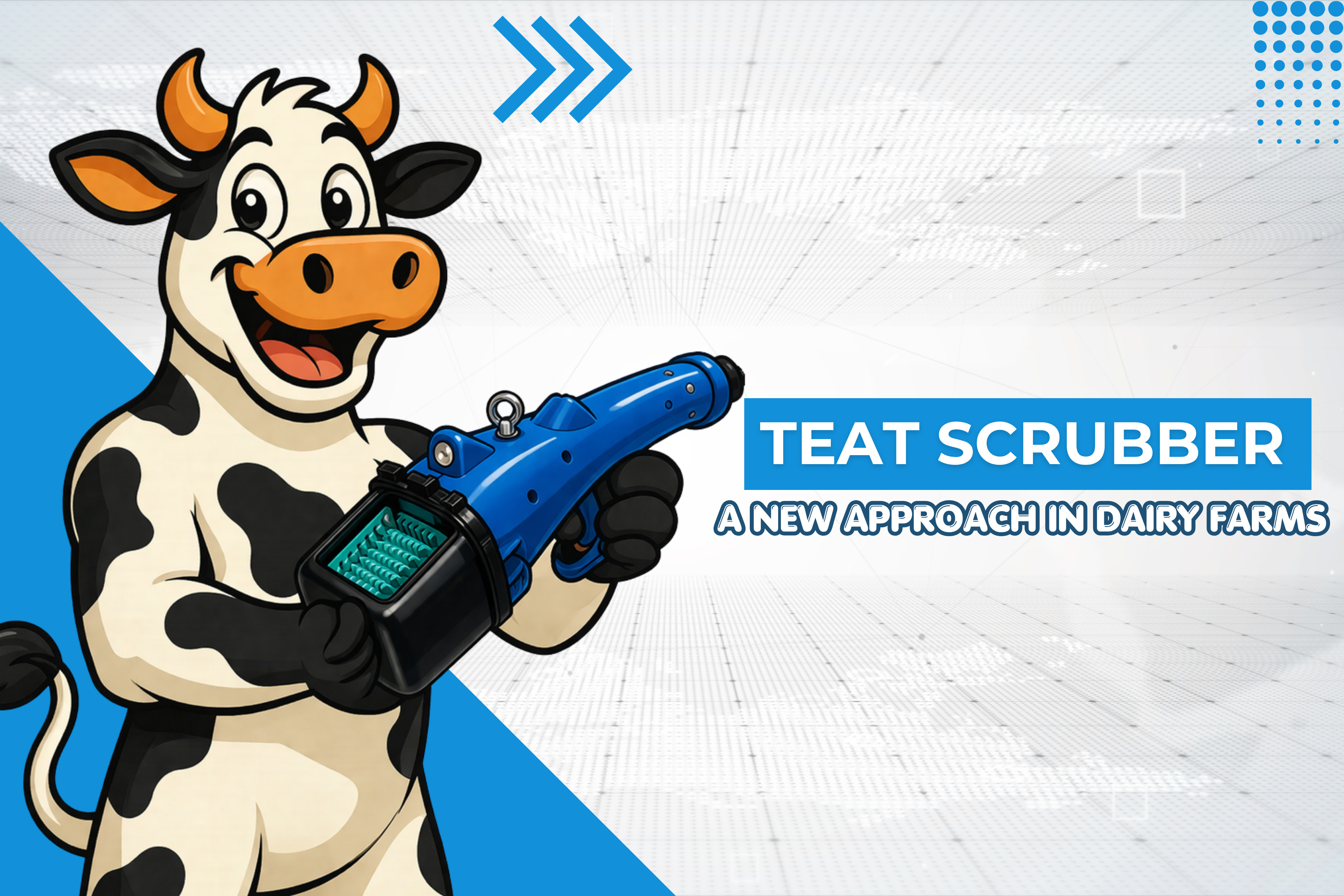
To address inefficiencies and variability in the milking routine, a new technology has been introduced: the automatic teat scrubber (TS). It replaces three conventional pre-milking tasks — pre-dipping, teat stripping, and teat wiping — with a single operation.
The TS device uses rotating brushes inside a housing with a handle and weighs about 1.8 kg. It is operated with a power grip. During use, the brushes surround each teat, remove debris, apply disinfectant, and stimulate milk let-down.
The primary goal of this system is to reduce variability associated with human performance, improve consistency in the milking process, and increase operational efficiency. By consolidating multiple manual steps into a single action, the TS has the potential to streamline workflow and reduce the complexity of the milking routine.
This leads to clear changes in how the work is done. In the conventional process, each teat is handled three times. With TS, each teat is treated once — a 67% reduction in repetition.
In terms of time, the average duration of teat preparation per cow decreases from approximately 5.5 seconds in the conventional process to 3.5 seconds with TS, reflecting a reduction of about 36%.
At the same time, TS changes how physical load is distributed. It reduces activation in the anterior deltoid (shoulder), but increases activation in the biceps and forearm muscles.
These changes are caused by the design of the device. Its higher weight and center of gravity increase grip force and load on the wrist. It also changes arm position — lowering shoulder elevation and increasing elbow flexion.
TS does not remove physical strain, it shifts it.
Reduced task time also does not guarantee lower total workload. Higher efficiency may allow workers to handle more cows, offsetting the benefit per task. TS is therefore a structural change in the process: it improves efficiency and consistency and reduces repetition and time, but redistributes load instead of eliminating it, and its overall effect depends on production demands and work organization.